

If you’ve ever felt a sharp pinch or deep ache in the front of your hip when sitting, squatting, or bending down, you’re not alone. This kind of pain is incredibly common—and one of the most overlooked causes is hip impingement.
Hip impingement, also known as femoroacetabular impingement (FAI), can quietly limit your movement, disrupt workouts, and make everyday activities uncomfortable. The good news? In many cases, physical therapy can help reduce pain and restore function without surgery.
Let’s break it down.
What Is Hip Impingement?
Hip impingement happens when the ball-and-socket joint of the hip doesn’t move smoothly. Instead of gliding freely, the bones make abnormal contact, especially during deeper hip movements like sitting, squatting, or lunging.
Over time, this repeated contact can:
- Irritate the joint
- Stress the cartilage and labrum
- Cause pain, stiffness, and reduced range of motion
Many people have hip impingement without knowing it—until pain starts interfering with daily life.
Why Squatting Makes Hip Impingement Worse
Squatting combines hip flexion, rotation, and load—a perfect storm for hip impingement.
During a squat:
- The hip bends deeply
- The ball of the hip moves closer to the edge of the socket
- Poor mechanics or limited mobility increase joint stress
This is why people with hip impingement often feel:
- A pinch at the bottom of a squat
- Pain during deadlifts, lunges, or step-ups
- Uneven depth or shifting to one side
It’s not that squats are “bad”—it’s that your hip may not be tolerating that range or load yet.
Common Signs of Hip Impingement
Hip impingement doesn’t always feel the same for everyone, but common symptoms include:
- Deep pain in the front of the hip or groin
- Pinching sensation with bending or twisting
- Stiffness, especially in the morning or after sitting
- Reduced hip mobility
- Pain during exercise or sports
- Clicking or catching in the hip
Because symptoms can overlap with hip flexor strains or low back pain, hip impingement is often misdiagnosed or ignored.
Can Hip Impingement Get Better Without Surgery?
In many cases, yes.
While structural changes in the hip don’t disappear, pain and function can improve significantly with the right approach. Surgery is not always the first—or best—option.
This is where physical therapy comes in.
How Physical Therapy Helps Hip Impingement
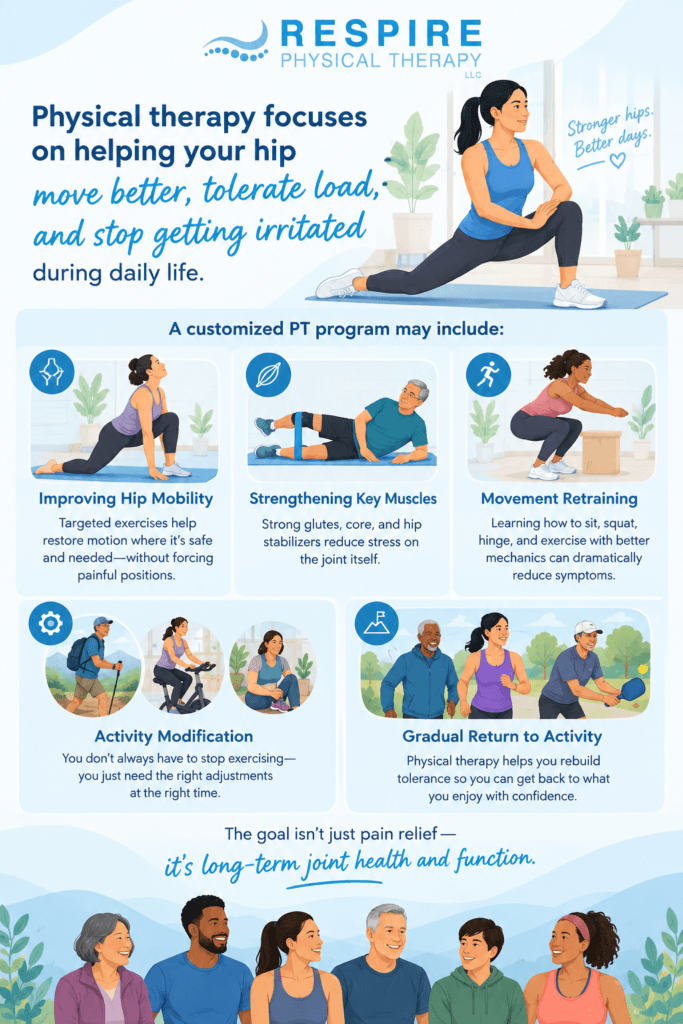
Physical therapy focuses on helping your hip move better, tolerate load, and stop getting irritated during daily life.
A customized PT program may include:
Improving Hip Mobility
Targeted exercises help restore motion where it’s safe and needed—without forcing painful positions.
Strengthening Key Muscles
Strong glutes, core, and hip stabilizers reduce stress on the joint itself.
Movement Retraining
Learning how to sit, squat, hinge, and exercise with better mechanics can dramatically reduce symptoms.
Activity Modification
You don’t always have to stop exercising—you just need the right adjustments at the right time.
Gradual Return to Activity
Physical therapy helps you rebuild tolerance so you can get back to what you enjoy with confidence.
The goal isn’t just pain relief—it’s long-term joint health and function.
When Should You See a Physical Therapist?
You don’t have to wait until pain is severe. Consider seeing a physical therapist if:
- Hip pain lasts more than a few weeks
- Sitting or squatting consistently causes discomfort
- Exercise or sports aggravate your hip
- You feel stiff, limited, or “stuck” in certain movements
Early intervention often leads to faster recovery and better outcomes.
The Bottom Line
Hip impingement is a common—but treatable—cause of hip pain, especially during sitting and squatting. While it can feel frustrating and limiting, you have options.
With the right physical therapy plan, many people are able to:
- Reduce pain
- Move more freely
- Return to exercise and daily activities
- Avoid or delay surgery
If you are experiencing hip pain that is limiting your daily activities, Respire PT’s physical therapists can help you get back to the life you love. Call Respire Physical Therapy at the Falls Church Location (703-671-1871) or the Annandale Location (571-369-6728) to schedule an appointment with one of our skilled Physical Therapists today! Click here to request an appointment online and we will contact you as soon as possible.

Tags: hip impingement, pt education, arlingtonva, regain your movement freedom, alexandriava, evidence based practice, springfieldva, burkeva, fallschurchva, annandaleva, Physical Therapy, painfreeliving, Respire Physical Therapy, washingtondc, physical therapist, health blog, movementismedicine, hip pain