

Pain along the inside of your ankle or foot can make everyday activities like walking, climbing stairs, or exercising uncomfortable. While there are several possible causes of inner ankle pain, one condition that physical therapists commonly evaluate is posterior tibialis tendinopathy.
The posterior tibialis tendon plays an important role in supporting the arch of your foot and helping control the movement of your foot and ankle. When this tendon becomes irritated or overloaded, it can cause pain and weakness that affect how you walk and move.
The good news is that physical therapy can often play an important role in managing symptoms, restoring strength, and helping you return to the activities you enjoy.
What Is the Posterior Tibialis Tendon?
The posterior tibialis is a muscle located deep in the back of your lower leg. Its tendon travels behind the inside of the ankle and attaches to several bones in the foot.
This tendon helps:
- Support the arch of the foot
- Control the position of the foot during walking
- Turn the foot inward
- Assist with pushing off during walking, running, and jumping
- Stabilize the ankle and foot during weight-bearing activities
Because the tendon is involved in many repetitive movements, it can become irritated when the demands placed on it exceed its ability to recover.
What Is Posterior Tibialis Tendinopathy?
Posterior tibialis tendinopathy refers to pain and dysfunction involving the posterior tibialis tendon. It can develop gradually from repetitive stress or increased activity, although symptoms may sometimes appear following an injury.
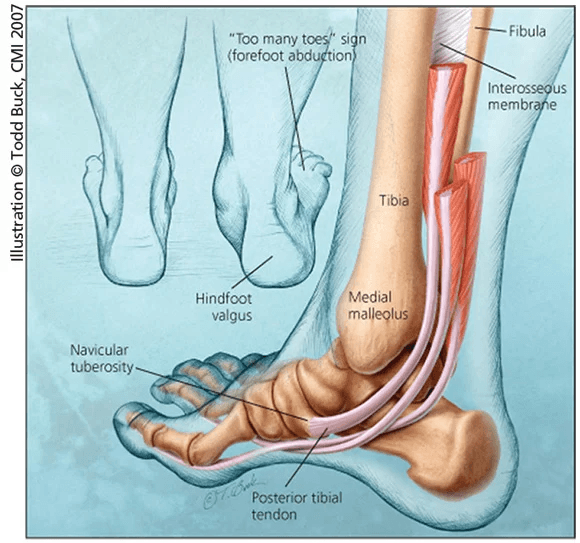
The term “tendinopathy” is often used because tendon problems can involve changes in the tendon as well as pain and reduced function. It is not necessarily the result of a single traumatic event.
Posterior tibialis tendinopathy may be more likely to develop when the tendon is repeatedly exposed to loads it is not currently prepared to handle.
What Does Posterior Tibialis Tendinopathy Feel Like?
Symptoms can vary from person to person, but common signs include:
- Pain along the inside of the ankle
- Pain or tenderness along the inside of the foot
- Swelling around the inner ankle
- Pain that increases with prolonged walking or standing
- Discomfort when running, jumping, or going up stairs
- Weakness when pushing off with the affected foot
- Difficulty performing a single-leg heel raise
- A feeling that the foot or ankle is unstable or weak
- Increasing difficulty supporting the arch of the foot
Some people notice symptoms initially during exercise but find that the discomfort gradually begins occurring during everyday activities as well.
What Causes Posterior Tibialis Tendinopathy?
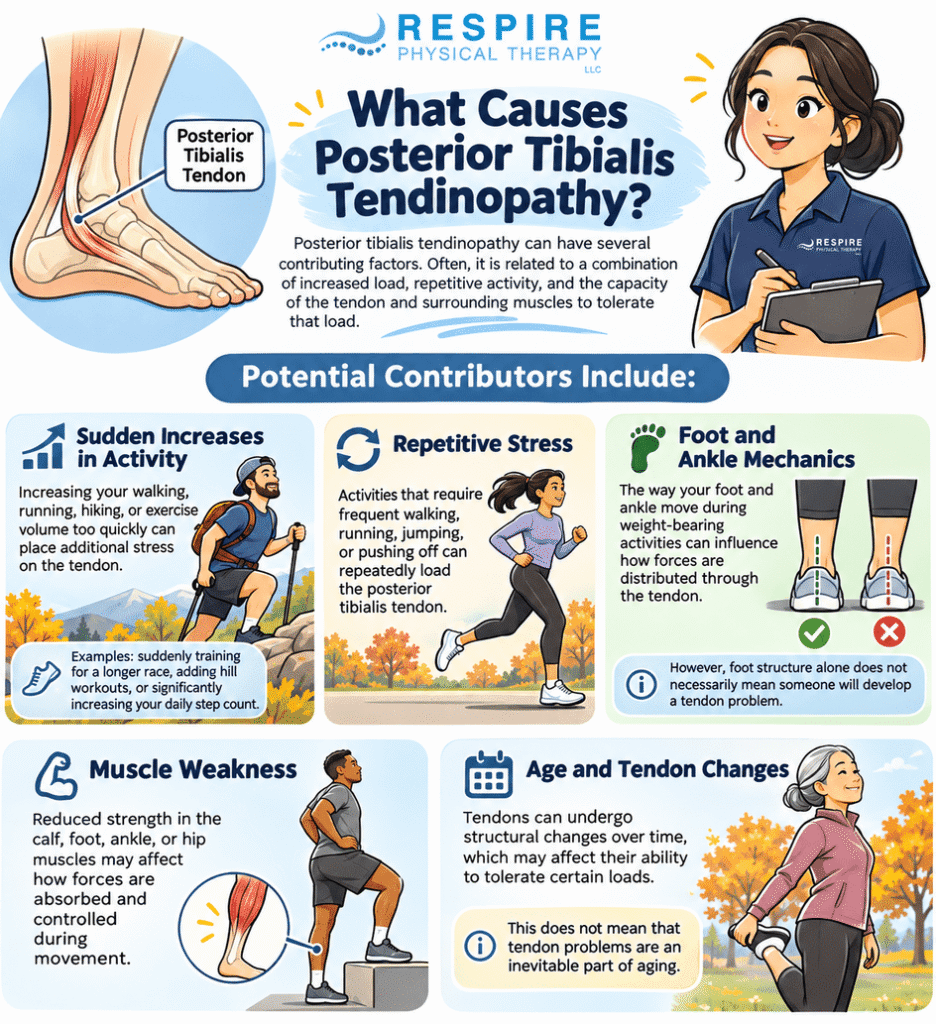
Posterior tibialis tendinopathy can have several contributing factors. Often, it is related to a combination of increased load, repetitive activity, and the capacity of the tendon and surrounding muscles to tolerate that load.
Potential contributors include:
Sudden Increases in Activity
Increasing your walking, running, hiking, or exercise volume too quickly can place additional stress on the tendon.
For example, suddenly training for a longer race, adding hill workouts, or significantly increasing your daily step count may contribute to symptoms.
Repetitive Stress
Activities that require frequent walking, running, jumping, or pushing off can repeatedly load the posterior tibialis tendon.
Foot and Ankle Mechanics
The way your foot and ankle move during weight-bearing activities can influence how forces are distributed through the tendon. However, foot structure alone does not necessarily mean someone will develop a tendon problem.
Muscle Weakness
Reduced strength in the calf, foot, ankle, or hip muscles may affect how forces are absorbed and controlled during movement.
Age and Tendon Changes
Tendons can undergo structural changes over time, which may affect their ability to tolerate certain loads. This does not mean that tendon problems are an inevitable part of aging.
Can Posterior Tibialis Tendinopathy Cause a Fallen Arch?
In some cases, dysfunction of the posterior tibialis tendon can be associated with progressive changes in foot shape, including a lowering of the arch.
The posterior tibialis tendon contributes to dynamic support of the medial arch. If the tendon becomes significantly impaired, the foot may have difficulty maintaining its normal position during weight-bearing.
However, not everyone with posterior tibialis tendinopathy will develop a fallen arch, and several factors can contribute to changes in foot structure.
If you notice a new or progressive change in the shape of your foot, increasing difficulty walking, or significant weakness, an evaluation by a qualified healthcare professional is appropriate.
How Is Posterior Tibialis Tendinopathy Diagnosed?
A physical therapist or other healthcare professional will typically begin with a detailed history and physical examination.
Your evaluation may include:
- Where your pain is located
- When your symptoms started
- Recent changes in activity
- Walking and running mechanics
- Foot and ankle range of motion
- Strength testing
- Single-leg balance
- Heel-raise testing
- Assessment of the foot and ankle during weight-bearing activities
Imaging is not always necessary. Depending on your symptoms, medical history, and examination findings, your healthcare provider may recommend imaging or referral to another medical professional.
Because inner ankle pain can have several causes, an appropriate evaluation is important for determining the underlying problem.
How Can Physical Therapy Help?
Physical therapy focuses on improving your ability to tolerate the activities that are important to you while addressing contributing factors.
Your treatment plan may include several components.
Progressive Strengthening
Strengthening is often an important part of rehabilitation. Exercises may target the posterior tibialis, calf muscles, foot muscles, and other muscles involved in controlling the lower extremity.
Your therapist may gradually progress exercises from basic movements to more functional activities such as single-leg exercises, hopping, running, or sport-specific movements.
Load Management
You do not necessarily have to stop all activity when you have posterior tibialis tendon pain.
Instead, your physical therapist can help you determine which activities are currently appropriate and how to gradually increase your activity without repeatedly exceeding your capacity.
This may involve temporarily modifying:
- Walking distance
- Running volume
- Hills
- Jumping
- Sports participation
- Exercise intensity
The goal is generally to find an appropriate balance between providing the tendon with enough stimulus to adapt while avoiding excessive aggravation.
Balance and Proprioception Training
Balance exercises can help improve control of the foot and ankle during weight-bearing activities.
Examples may include single-leg balance, reaching exercises, and progressively challenging dynamic movements.
Gait and Movement Training
Your physical therapist may assess how you walk, run, squat, climb stairs, or perform other activities relevant to your symptoms.
If movement strategies are contributing to excessive stress on the foot or ankle, your therapist can work with you on improving strength, coordination, and movement control.
Footwear and Support
In some cases, footwear modifications or temporary external support may help manage symptoms while you build strength and gradually increase activity.
The appropriate approach depends on the individual. Your physical therapist can help determine whether changes to footwear, inserts, or other forms of support may be useful.
When Should You See a Physical Therapist?
Consider scheduling an evaluation if your inner ankle or foot pain:
- Persists despite modifying your activity
- Interferes with walking or exercise
- Is gradually getting worse
- Is accompanied by weakness
- Makes single-leg heel raises difficult
- Is affecting your ability to participate in work, sports, or recreational activities
- Is associated with changes in the shape of your foot or arch
Early evaluation can help identify contributing factors and provide a structured plan for returning to normal activity.
Takeaway
Pain along the inside of your ankle shouldn’t automatically be dismissed as something you simply need to “push through.” Posterior tibialis tendinopathy is one possible cause of inner ankle and foot pain, particularly when symptoms are associated with activity, weakness, or difficulty supporting the foot.
A comprehensive physical therapy evaluation can help determine whether the posterior tibialis tendon is contributing to your symptoms and identify an appropriate rehabilitation strategy.
With progressive strengthening, appropriate activity modification, and a gradual return to higher-level activities, many people can improve their function and return to the activities they enjoy.
If you’re experiencing persistent pain along the inside of your ankle or foot, consider speaking with a physical therapist or other qualified healthcare professional for an individualized evaluation.
If you are experiencing ankle pain that is limiting your daily activities, Respire PT’s physical therapists can help you get back to the life you love. Call Respire Physical Therapy at the Annandale Location (571-369-6728) or the Falls Church Location (703-671-1871) to schedule an appointment with one of our skilled Physical Therapists today! Click here to request an appointment online and we will contact you as soon as possible.

Tags: ptworks, physical therapist, fairfaxva, Foot Pain, annandaleva, painfreeliving, washingtondc, health blog, choosept, movementismedicine, arlingtonva, pt education, Physical Therapy, alexandriava, evidence based practice, Respire Physical Therapy, springfieldva, burkeva, ankle pain, fallschurchva, tibialis tendinopathy