
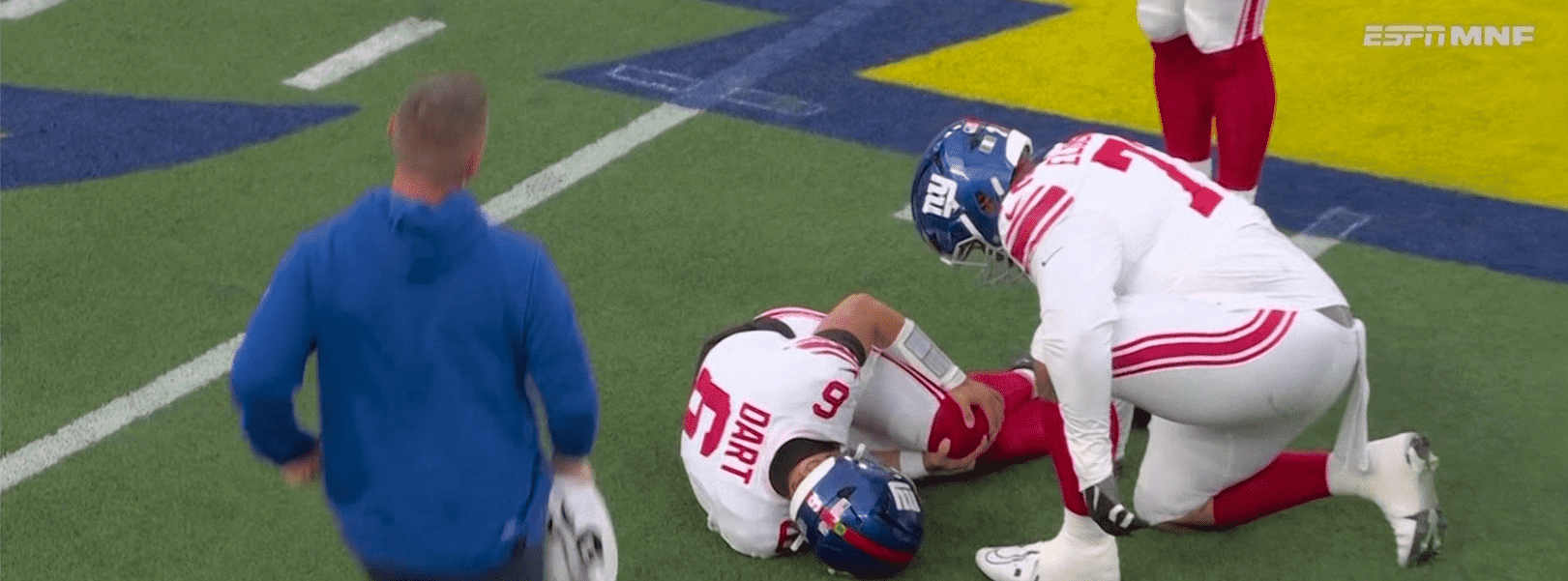
Seeing an athlete collapse on the field holding their knee sends an immediate wave of concern through teammates, coaches, and fans alike. Moments like this highlight how quickly a high impact play can sideline even the most elite athletes.
While a sudden knee injury feels overwhelming, understanding the anatomy behind the joint, how knee stability works, and what a structured rehabilitation timeline looks like turns anxiety into an actionable path toward recovery.
What Is the MCL?
The Medial Collateral Ligament (MCL) is one of the four primary stabilizing ligaments in the knee joint. Located along the inner side of your knee, it connects the bottom of the thigh bone (femur) to the top of the shin bone (tibia). The primary role of the MCL is to prevent the knee from collapsing inward toward the opposite leg which is a movement pattern known medically as valgus stress.
How MCL Sprains Happen?
MCL injuries typically occur in two scenarios:
- Direct Impact: A contact blow to the outside of the knee (often seen in football or soccer tackles) forces the joint inward, stretching or tearing the ligament on the inside.
- Non-Contact Stress: A sudden change of direction, twisting motion, or awkward landing where the foot stays planted while the knee buckles inward.
Knee Stability: Why Ligaments and Muscles Work Together
Knee stability relies on two complementary systems: static stabilizers and dynamic stabilizers.
- Static Stabilizers (Ligaments): Ligaments like the MCL act as tough, fibrous ropes holding the bones together. When a ligament suffers a sprain (micro-tears or a full tear), that static boundary is compromised, making the joint feel loose or unstable.
- Dynamic Stabilizers (Muscles): Surrounding muscles specifically the quadriceps, hamstrings, and gluteal complex—act as dynamic shock absorbers. When static ligament support is temporarily weakened by a sprain, targeted physical therapy trains the dynamic muscle system to step up and stabilize the joint.
The MCL Strengthening and Recovery Timeline
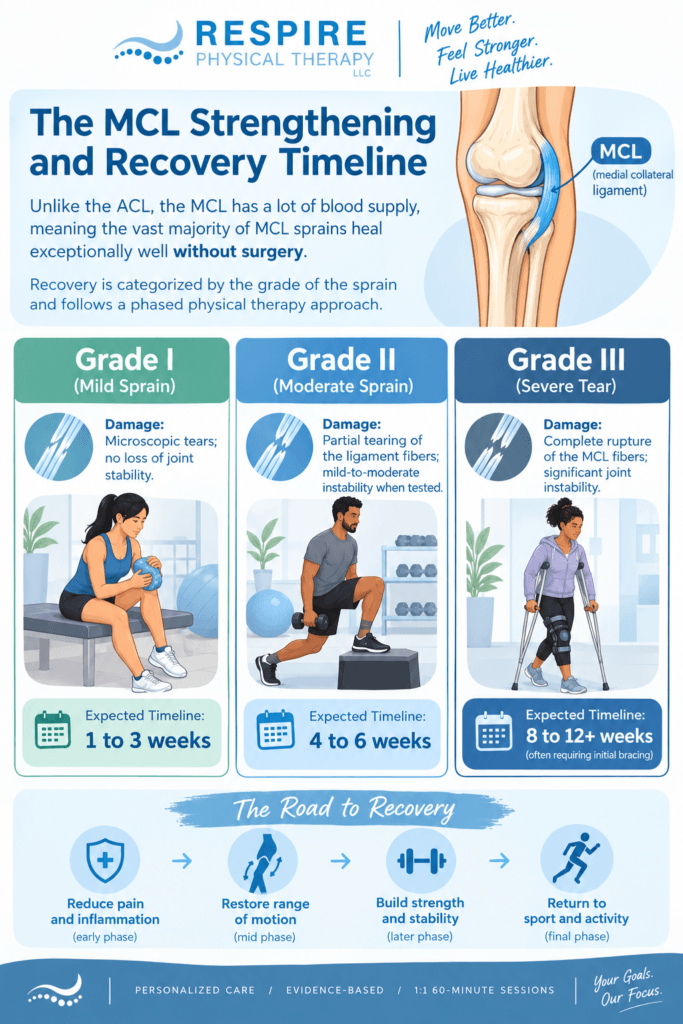
Unlike the ACL, the MCL has a lot of blood supply, meaning the vast majority of MCL sprains heal exceptionally well without surgery. Recovery is categorized by the grade of the sprain and follows a phased physical therapy approach.
Grade I (Mild Sprain)
- Damage: Microscopic tears; no loss of joint stability.
- Expected Timeline: 1 to 3 weeks.
Grade II (Moderate Sprain)
- Damage: Partial tearing of the ligament fibers; mild-to-moderate instability when tested.
- Expected Timeline: 4 to 6 weeks.
Grade III (Severe Tear)
- Damage: Complete rupture of the MCL fibers; significant joint instability.
- Expected Timeline: 8 to 12+ weeks (often requiring initial bracing).
Physical Therapy Rehabilitation Phases
Phase 1: Protect & Restore (Weeks 1–2)
- Goals: Control acute swelling, manage pain, and protect the healing ligament.
- Key Focus:
- Resting from aggravating activities and wearing a protective hinged knee brace if necessary.
- Gentle, non-weight-bearing range-of-motion exercises (like heel slides) to prevent stiffness.
- Early isometric muscle activation (quadriceps sets and straight-leg raises) to keep the leg muscles firing.
Phase 2: Load & Balance (Weeks 3–5)
- Goals: Restore full motion, eliminate limping, and build basic lower-body strength.
- Key Focus:
- Transitioning to full weight-bearing movement.
- Controlled closed-kinetic-chain exercises (squats, step-ups, leg presses) that do not place direct valgus stress on the inner knee.
- Proprioceptive and balance training (single-leg stands) to rebuild neuromuscular control.
Phase 3: Dynamic Power & Side-to-Side Motion (Weeks 6–8+)
- Goals: Rebuild multi-directional strength, power, and high-level movement patterns.
- Key Focus:
- Lateral movement drills (shuffling, side lunges) introduced gradually once straight-line movement is pain-free.
- Agility drills, plyometrics, and sport-specific movements to prepare for full activity.
- Objective functional testing (comparing strength and single-leg hop distance against the uninjured leg) before final return-to-play clearance.
If you are experiencing knee pain or suffered a MCL sprain, Respire PT’s physical therapists can help you get back to the activities and sports you love. Call Respire Physical Therapy at the Falls Church Location (703-671-1871) or the Annandale Location (571-369-6728) to schedule an appointment with one of our skilled Physical Therapists today! Click here to request an appointment online and we will contact you as soon as possible.

Tags: painfreeliving, knee pain, washingtondc, health blog, movementismedicine, return to sport, choosept, pt education, arlingtonva, regain your movement freedom, alexandriava, movement is medicine, fallschurchva, evidence based practice, Physical Therapy, ptworks, mcl sprain, Respire Physical Therapy, annandaleva, physical therapist