

De Quervain’s tenosynovitis is an irritation of two tendons that run along the thumb side of the wrist: the abductor pollicis longus (APL) and extensor pollicis brevis (EPB).
These tendons help move the thumb away from the hand and extend the thumb. They pass through a narrow compartment near the wrist. Repetitive movement or increased stress on these tendons can cause irritation, swelling, and pain.
Despite the name, De Quervain’s is not necessarily caused by one specific injury. Symptoms can develop gradually following repetitive hand and wrist activities or after a sudden increase in activity.
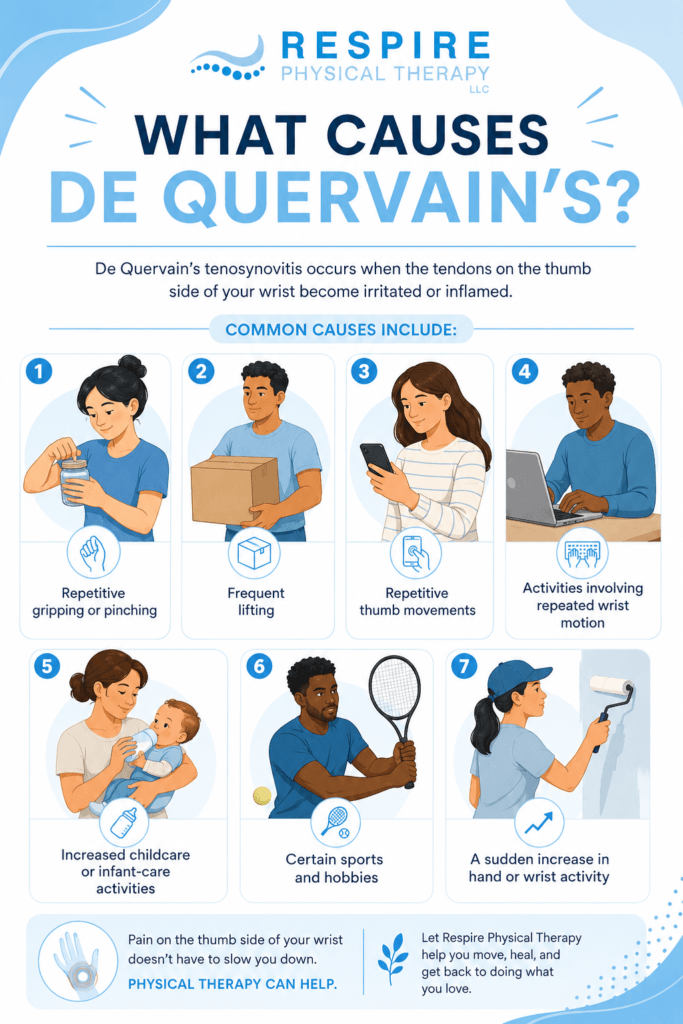
What Causes De Quervain’s?
- Repetitive gripping or pinching
- Frequent lifting
- Repetitive thumb movements
- Activities involving repeated wrist motion
- Increased childcare or infant-care activities
- Certain sports and hobbies
- A sudden increase in hand or wrist activity
Common Symptoms
- Pain along the thumb side of the wrist
- Tenderness near the base of the thumb
- Pain with gripping, lifting, or pinching
- Swelling around the wrist or thumb
- Difficulty moving the thumb or wrist comfortably
- Pain that may extend from the wrist into the lower thumb or forearm
How Can Physical Therapy Help?
Physical therapy focuses on reducing irritation while gradually restoring the strength and function of the thumb and wrist.
1. Activity Modification
One of the first steps in treatment is identifying activities that are aggravating the tendons. Your physical therapist can help you modify how you perform everyday tasks so you can continue using your hand while reducing unnecessary stress on the irritated area.
2. Pain and Symptom Management
- Gentle soft-tissue techniques
- Therapeutic exercises
- Activity modification
- Education on positioning and movement
- Cold therapy when appropriate
- Bracing or splinting recommendations
3. Restoring Wrist and Thumb Mobility
Pain can cause people to avoid moving the thumb or wrist, which may lead to stiffness. Your physical therapist can prescribe gentle range-of-motion exercises designed to maintain mobility without excessively irritating the tendons.
4. Progressive Strengthening
- Thumb muscles
- Wrist muscles
- Grip strength
- Forearm muscles
- Overall hand function
The Bottom Line
De Quervain’s tenosynovitis can make everyday activities painful, but you don’t have to simply live with wrist and thumb pain. Physical therapy can help identify contributing factors, reduce irritation, restore mobility, and progressively rebuild strength. Call Respire Physical Therapy at the Falls Church Location (703-671-1871) or the Annandale Location (571-369-6728) to schedule an appointment with one of our skilled Physical Therapists today! Click here to request an appointment online and we will contact you as soon as possible.
Tags: pt education, alexandriava, evidence based practice, fallschurchva, thumb pain, ptworks, De Quervain’s tenosynovitis, annandaleva, painfreeliving, washingtondc, Respire Physical Therapy, wrist pain, health blog, movementismedicine, choosept, mommy's wrist pain, arlingtonva