

The hip is a ball-and-socket joint. The ball at the top of the thigh bone, called the femoral head, fits into the socket of the pelvis, called the acetabulum.
With femoroacetabular impingement, the bones of the hip may come into contact in a way that causes pinching or irritation during certain movements. This can place stress on the surrounding structures, including the labrum and cartilage.
There are several types of hip impingement, including:
- Cam impingement: An irregular shape at the femoral head or neck causes increased contact within the hip joint.
- Pincer impingement: Extra bone around the rim of the hip socket can cause the socket to cover too much of the femoral head.
- Mixed impingement: A combination of both cam and pincer features.
It’s important to note that some people have imaging findings consistent with FAI but do not experience pain. Symptoms and functional limitations are just as important as imaging when determining the best treatment approach.
Common Symptoms of Hip Impingement
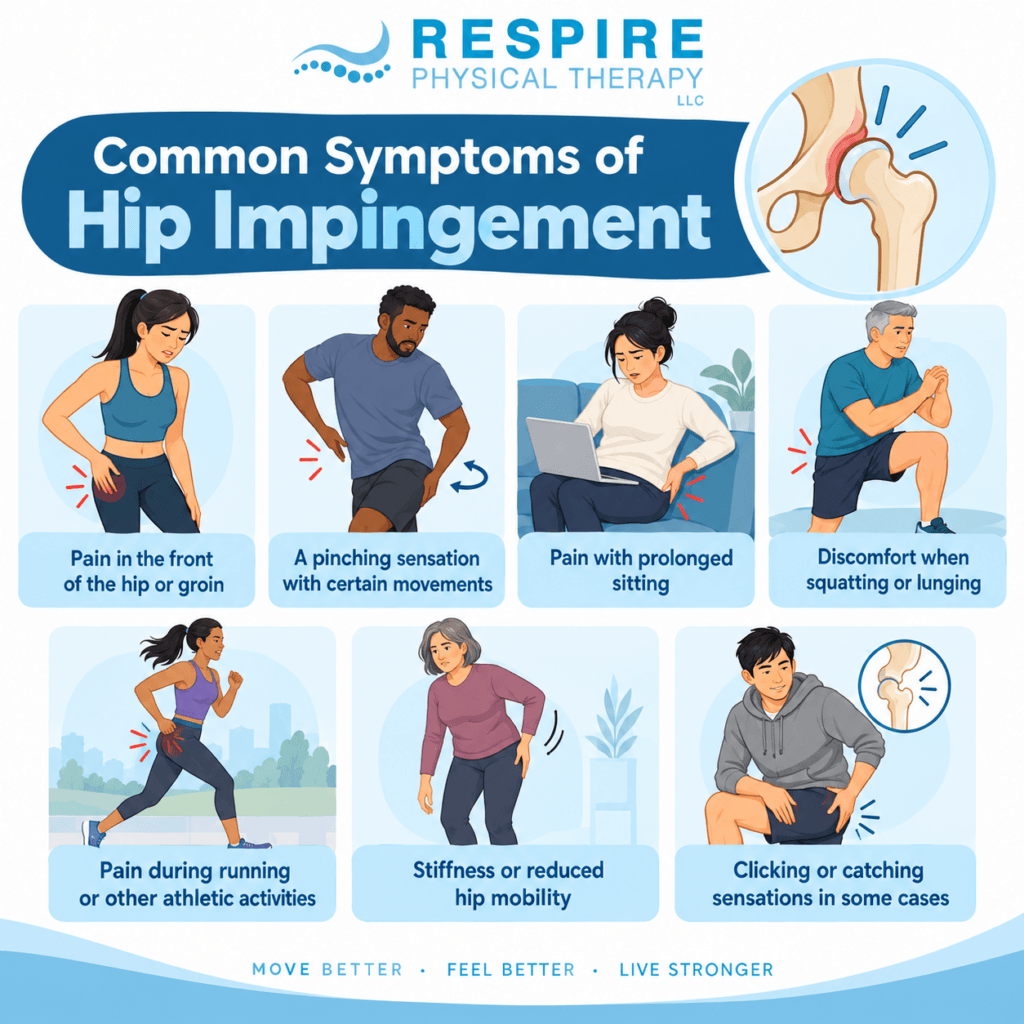
- Pain in the front of the hip or groin
- A pinching sensation with certain movements
- Pain with prolonged sitting
- Discomfort when squatting or lunging
- Pain during running or other athletic activities
- Stiffness or reduced hip mobility
- Clicking or catching sensations in some cases
How Can Physical Therapy Help?
Physical therapy takes an individualized approach to managing hip impingement. Treatment focuses not only on the painful hip but also on movement patterns, strength, mobility, and the activities contributing to symptoms.
1. Identifying Aggravating Movements
Your physical therapist will evaluate which movements and activities reproduce your symptoms. This may include assessing activities such as:
- Squatting
- Running
- Walking
- Climbing stairs
- Sitting
- Exercise or sports-specific movements
2. Improving Hip Mobility
Hip impingement can be associated with stiffness and movement limitations. Your physical therapist may use targeted mobility exercises and, when appropriate, manual therapy techniques to address movement restrictions.
The goal is not simply to increase flexibility but to improve comfortable, functional movement.
3. Strengthening the Muscles Around the Hip
Weakness or poor control of the muscles surrounding the hip and pelvis may contribute to inefficient movement patterns.
A physical therapy program may focus on strengthening the:
- Gluteal muscles
- Hip rotators
- Hip flexors and extensors
- Core muscles
- Muscles that support pelvic stability
4. Improving Movement and Mechanics
How you move can influence the stress placed on your hip. A physical therapist can assess movement patterns during activities such as squatting, running, walking, or participating in sports.
Treatment may focus on improving:
- Hip and pelvic control
- Lower-extremity alignment
- Balance and stability
- Movement coordination
- Sport- or activity-specific mechanics
5. Creating a Safe Return-to-Activity Plan
Completely avoiding activity isn’t always necessary—or beneficial. Physical therapy can help you gradually return to the activities you enjoy while managing symptoms and progressively increasing the demands placed on the hip.
Your treatment plan may be adjusted based on your goals, whether that means returning to running, strength training, recreational sports, or simply moving through daily activities without pain.
Can Physical Therapy Help You Avoid Surgery?
For many individuals, conservative treatment is an appropriate first step for managing symptoms related to hip impingement. Physical therapy can help improve strength, movement, and function while reducing pain.
However, every situation is different. If symptoms do not improve with conservative care, or if there is concern for significant structural damage, your healthcare provider may recommend additional imaging, injections, or consultation with an orthopedic specialist.
A physical therapist can also help determine when further medical evaluation may be appropriate.
The Bottom Line
If you’re experiencing persistent hip or groin pain, consider speaking with a physical therapist or healthcare provider to determine the best next step for you. Physical therapy can help identify contributing factors, reduce irritation, restore mobility, and progressively rebuild strength. Call Respire Physical Therapy at the Falls Church Location (703-671-1871) or the Annandale Location (571-369-6728) to schedule an appointment with one of our skilled Physical Therapists today! Click here to request an appointment online and we will contact you as soon as possible.

Tags: annandaleva, physical therapist, painfreeliving, washingtondc, hip pain, hip impingement, pt education, choosept, regain your movement freedom, arlingtonva, movement is medicine, alexandriava, evidence based practice, fallschurchva, ptworks, Physical Therapy, Respire Physical Therapy