

Posture plays a major role in how your body moves, performs, and manages pain. Whether you are dealing with neck tension, shoulder discomfort, low back pain, or recurring injuries, posture is often part of the picture.
A physical therapy postural assessment goes beyond simply asking someone to “stand up straight.” It is a detailed evaluation of alignment, side-to-side symmetry, and movement patterns to determine how your body is distributing load.
Physical Therapists assess both:
- Plumb line alignment (side view)
- Left-to-right symmetry (front and back views)
Below is a detailed breakdown of exactly what physical therapists look at during a comprehensive posture evaluation.
Visual Reference: Full Body Postural Landmarks
Here is a traditional postural assessment reference used in orthopedic and physical therapy settings. This image illustrates common bony landmarks used to assess alignment and symmetry from all three views.
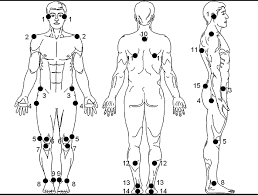
Lateral View (Plumb Line Alignment)
In the side view, we imagine a vertical plumb line passing through specific anatomical landmarks. Proper alignment minimizes stress on joints and soft tissues.
Key Landmarks Assessed:
- Head: Ear lobe (external auditory meatus)
- Shoulder: Acromion process
- Spine: Bodies of cervical and lumbar vertebrae
- Hip: Greater trochanter
- Knee: Slightly posterior to the patella (center of knee joint)
- Ankle: Slightly anterior to the lateral malleolus
What Physical Therapists Look For:
- Forward head posture
- Excess thoracic kyphosis
- Increased or decreased lumbar lordosis
- Knee hyperextension
- Forward or backward trunk lean
If these landmarks do not stack vertically, it suggests altered load distribution that may contribute to pain or dysfunction.
Anterior View (Symmetry Assessment)
From the front, posture assessment focuses on side-to-side symmetry.
Key Landmarks Assessed:
- Head: Nose and chin centered in midline
- Shoulders: Acromion processes / AC joints level
- Pelvis: Anterior Superior Iliac Spines (ASIS) level
- Knees: Patella height and orientation
- Feet: Tibial tuberosity alignment and space between 1st and 2nd metatarsals
What Physical Therapists Look For:
- Head tilt or rotation
- Uneven shoulder height
- Pelvic obliquity
- Knee valgus or varus alignment
- Unequal foot pronation
Even subtle asymmetries can indicate muscular imbalances or compensatory patterns.
Posterior View (Symmetry Assessment)
The back view allows us to evaluate scapular positioning, pelvic symmetry, and lower extremity alignment.
Key Landmarks Assessed:
- Head: Occipital protuberance and spinous processes
- Shoulders: Scapulae (inferior angles and medial borders)
- Pelvis: Posterior Superior Iliac Spines (PSIS) and iliac crests
- Knees: Joint line / popliteal fossa
- Ankle/Foot: Calcaneus alignment and Achilles tendon orientation
What Physical Therapists Look For:
- Scoliosis or spinal deviation
- Scapular winging or asymmetry
- Uneven iliac crests
- Tibial rotation
- Calcaneal valgus or varus
Symmetry here is crucial for efficient force transfer through the kinetic chain.
Static vs. Dynamic Posture
While static posture provides valuable insight, physical therapists also assess:
- Gait
- Squatting mechanics
- Single-leg stance
- Functional movements
Sometimes posture appears symmetrical at rest but becomes asymmetrical under load.
Why This Matters
Poor alignment does not automatically mean pain but repeated stress on asymmetrical structures over time often leads to dysfunction. By evaluating plumb line alignment, bony landmark positioning, side-to-side symmetry, and movement control, physical therapists can design individualized programs targeting mobility, strength, and neuromuscular control.
If you are experiencing poor posture, persistent discomfort, or feel uneven during movement, Respire’s physical therapists can help you get back to the life you love. Call Respire Physical Therapy at the Falls Church Location (703-671-1871) or the Annandale Location (571-369-6728) to schedule an appointment with one of our skilled Physical Therapists today! Click here to request an appointment online and we will contact you as soon as possible.

Tags: pain free living, mobility, health blog, posture correction, choosept, pt education, Physical Therapy, arlingtonva, movement is medicine, Respire Physical Therapy, alexandriava, evidence based practice, fallschurchva, physical therapist, ptworks, posture control, annandaleva, washingtondc