
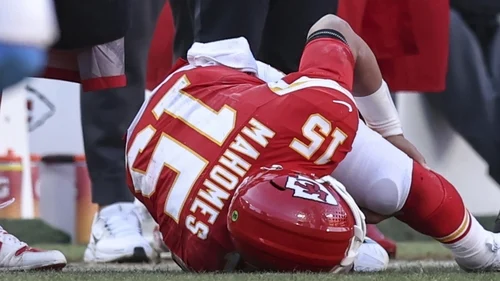
The knee is one of the most important and commonly injured joints in the body. Whether you are an athlete, a weekend warrior, or someone who simply wants to stay active without pain, understanding how your knee works can help you prevent injury and recover faster.
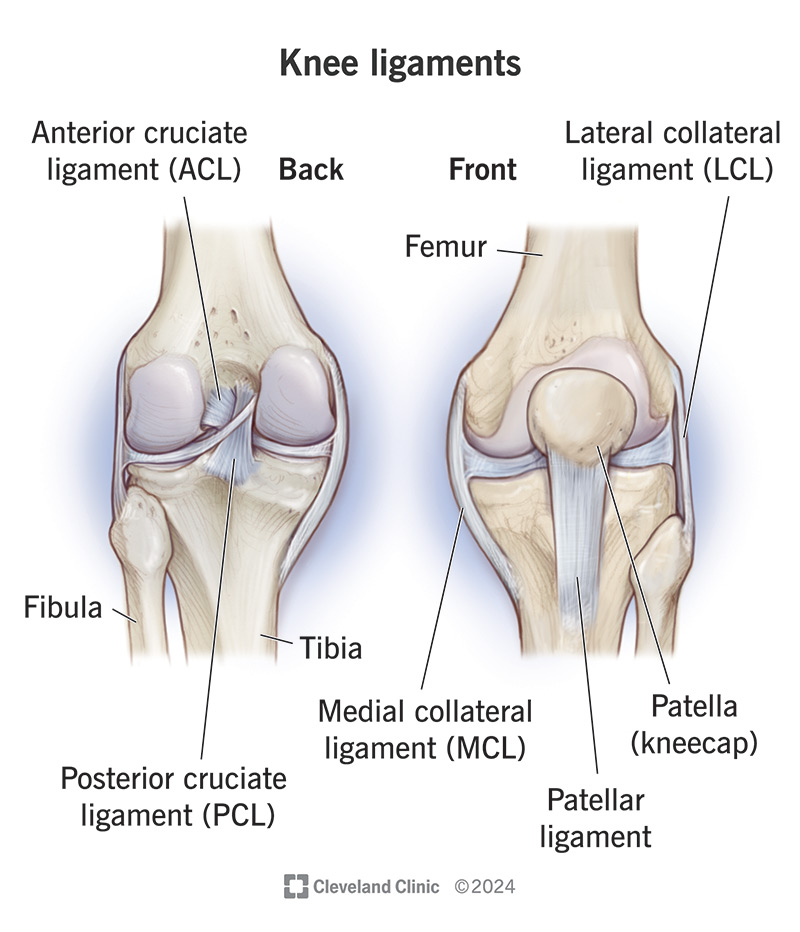
At the core of knee stability are four major ligaments. These ligaments act like strong ropes, connecting bones and keeping your knee stable during walking, running, jumping, and twisting.
This article will break down the four main ligaments of the knee and the role each one plays.
1. Anterior Cruciate Ligament (ACL)
Function: Prevents forward movement and rotation of the tibia (shin bone)
The ACL is one of the most well-known knee ligaments and one of the most frequently injured. It helps control rotational movements and prevents the shin bone from sliding too far forward relative to the thigh bone.
Common ACL injuries occur during:
- Sudden stops or pivots
- Jumping and landing awkwardly
- Sports like soccer, basketball, skiing, and football
2. Posterior Cruciate Ligament (PCL)
Function: Prevents backward movement of the tibia
The PCL works opposite the ACL and is actually stronger and less commonly injured. It stabilizes the knee when force pushes the shin bone backward.
Common PCL injuries occur during:
- Car accidents (dashboard injuries)
- Falls onto a bent knee
- Direct contact sports
3. Medial Collateral Ligament (MCL)
Function: Resists inward (valgus) stress on the knee
The MCL runs along the inside of the knee and protects it from forces that push the knee inward.
MCL injuries often happen due to:
- Direct blows to the outside of the knee
- Sudden changes in direction
- Sports like football, soccer, and hockey
4. Lateral Collateral Ligament (LCL)
Function: Resists outward (varus) stress on the knee
The LCL is located on the outside of the knee and stabilizes it against forces that push the knee outward.
LCL injuries are less common but can occur with:
- Trauma to the inside of the knee
- High-impact sports
- Combined ligament injuries
Why Knee Ligament Health Matters
When one or more knee ligaments are injured, the joint can become unstable leading to pain, swelling, limited movement, and long-term issues like arthritis if not treated properly.
Physical therapy can help by:
- Reducing pain and swelling
- Restoring strength and range of motion
- Improving balance and joint control
- Preventing future injuries
- Helping patients avoid or recover from surgery
If you have knee pain that limits your daily activities, Respire PT’s physical therapists can help you get back to the life you love. Call Respire Physical Therapy at the Falls Church Location (703-671-1871) or the Annandale Location (571-369-6728) to schedule an appointment with one of our skilled Physical Therapists today! Click here to request an appointment online and we will contact you as soon as possible.